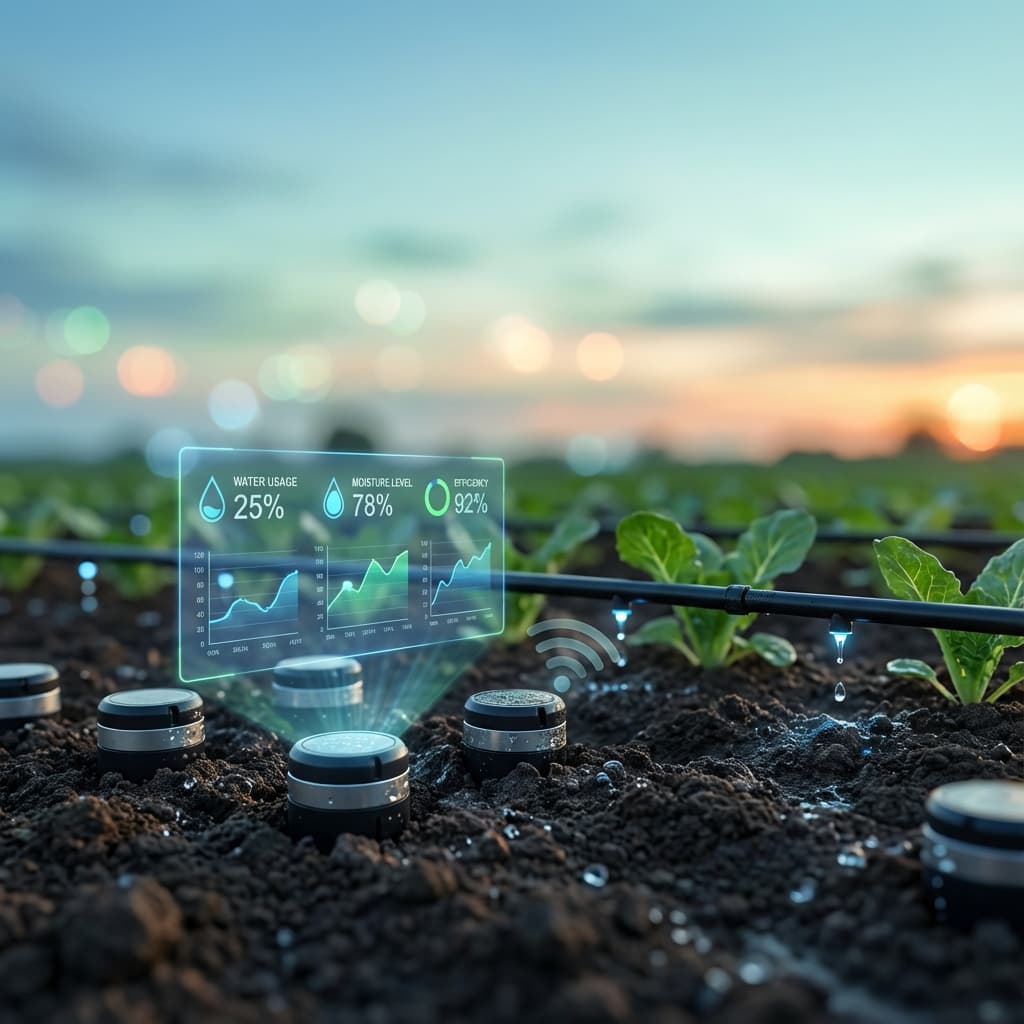
Smart IoT soil-moisture sensors combined with AI irrigation scheduling cut farm water use by 30–40% while maintaining or improving yields — with typical ROI in 6–14 months.
Agriculture accounts for ~70% of global freshwater withdrawals (FAO AQUASTAT, 2022). Moving from calendar-based to sensor- and ET₀-based irrigation also lowers pumping energy costs and supports modest yield gains by eliminating both water stress and over-irrigation damage.
What Is Agricultural Water Optimization?
Agricultural water optimization is the practice of matching irrigation water supply to actual crop water demand using soil-moisture sensors, weather data, evapotranspiration (ET₀) calculations, and AI scheduling. Instead of running fixed calendar-based irrigation, water is applied when the root zone actually needs it and withheld when rain or existing moisture makes it unnecessary.
The technique is applied across row crops, orchards, and vegetable production, and it delivers three compounding benefits: water savings, energy savings (less pumping), and yield improvement. Platforms like WiseYield combine FAO-56 Penman-Monteith ET₀ calculations with AI — see the irrigation-scheduling feature or start with a 14-day free trial.
Smart Irrigation at a Glance
Smart IoT soil moisture sensors combined with AI-powered irrigation management can reduce farm water consumption by 30-40% while maintaining or improving crop yields (Agricultural Water Management systematic review, 2023). With irrigation accounting for approximately 70% of global freshwater withdrawals (Source: FAO AQUASTAT, 2022) — precision water management is no longer optional. It's essential for sustainable and profitable farming.
This guide covers how smart sensors work, the AI algorithms that transform sensor data into irrigation strategies, the ROI math (with a typical 6-14 month payback), and implementation best practices for farms of all sizes. Additional benefits include lower energy costs from reduced pumping and modest yield gains from avoiding both water stress and over-irrigation alongside the water savings.
The Problem with Traditional Irrigation
Traditional irrigation methods rely on schedules, visual inspection, or simple timers. This approach typically results in:
The fundamental issue: farmers lack real-time data on actual soil moisture levels where plant roots are located. Visual inspection shows surface conditions, but roots access water from deeper soil layers. This information gap leads to guesswork-based irrigation decisions.
How Smart Sensors Work
Modern soil moisture sensors provide precision data that eliminates guesswork:
Multi-Depth Monitoring
Sensors measure moisture at multiple depths (6", 12", 24", 36") to track the full root zone profile. This reveals exactly where water is available or depleted.
Real-Time Data
Continuous monitoring (every 15-30 minutes) provides up-to-the-minute soil conditions, enabling immediate response to changes.
Depletion Rate Analysis
AI analyzes how quickly soil moisture depletes based on crop stage, weather conditions, and soil type—predicting when irrigation will be needed.
AI-Powered Irrigation Management
Sensors provide data, but AI transforms that data into optimal irrigation strategies:
Intelligent Decision-Making
- •Weather Integration: AI considers upcoming precipitation forecasts—if rain is predicted in 48 hours, irrigation is delayed to avoid waste
- •Crop Stage Optimization: Water requirements vary by growth stage—AI adjusts irrigation to match current plant needs
- •Variable Rate Application: Different field zones have different water-holding capacities—AI prescribes zone-specific irrigation rates
- •Deficit Irrigation Strategies: For certain crops, controlled water stress at specific stages improves quality without reducing yield—AI manages this precisely
What the Research Shows
Across published studies of sensor-based irrigation, the pattern of improvement is consistent:
Reduction in water use compared to traditional schedule-based irrigation, with no yield sacrifice (Agricultural Water Management systematic review, 2023)
Lower pumping costs from reduced irrigation frequency and optimized timing
Improvement from eliminating water stress and avoiding over-irrigation damage
Fewer manual irrigation checks and adjustments through automation
Implementation Considerations
Successfully deploying smart sensor irrigation requires planning:
Sensor Placement
Position sensors to represent different field zones—typically 1-3 sensors per 40-100 acres depending on field variability. Place in representative locations avoiding field edges or unusual spots.
Calibration
Sensors must be calibrated to soil type for accuracy. Most modern sensors include automatic calibration, but initial validation against soil samples ensures reliability.
Integration
Maximum value comes from integrating sensors with automated irrigation controls. This allows AI to not just recommend irrigation, but execute it automatically at optimal times (including nighttime to reduce evaporation).
Connectivity
Most sensors use cellular or LoRaWAN connectivity. Cellular coverage is adequate in many agricultural areas, and LoRaWAN provides low-power, long-range alternatives for remote locations.
ROI and Payback Period
Smart irrigation sensor systems typically cost $500-1,200 per sensor station (monitoring 40-100 acres). Here's an illustrative worked example for a 500-acre operation — plug in your own water, energy, and crop figures to estimate your numbers:
Key Takeaways
- ✓Smart sensors reduce water use by 30-40% while maintaining or improving yields
- ✓AI transforms sensor data into precise irrigation strategies based on weather, crop stage, and soil conditions
- ✓ROI is typically achieved within 6-14 months through water, energy, and yield improvements
- ✓Success requires proper sensor placement, calibration, and integration with irrigation controls
- ✓Water scarcity makes efficiency gains essential—smart irrigation is now a necessity, not a luxury
Sources & Citations
Statistics and claims on this page are drawn from peer-reviewed research and authoritative agricultural data.
- Agricultural Water Management (2023). Systematic review of smart/sensor-based irrigation scheduling — water-savings benchmarks across crop systems.
- FAO AQUASTAT (2022). Global water withdrawals — agriculture sector share.
- USDA Natural Resources Conservation Service. Irrigation Water Management conservation practice standards.
- University of Nebraska-Lincoln Extension. Pumping energy efficiency and irrigation scheduling ROI.
- FAO Irrigation and Drainage Paper 56. Crop evapotranspiration (ET₀) Penman-Monteith reference method.
- CGIAR (2021). Water stress and yield loss in rainfed and irrigated systems.
- FAO (2020). Water-use efficiency and over-irrigation in traditional schedule-based systems.
Optimize Your Water Usage with WiseYield
WiseYield integrates soil moisture data, weather forecasts, and crop requirements to deliver precise irrigation recommendations that save water and boost yields.
Frequently Asked Questions
How much water can smart irrigation save?
Smart IoT soil moisture sensors combined with AI-powered irrigation scheduling can reduce farm water consumption by 30-40% compared to traditional schedule-based irrigation, without sacrificing crop yields (Agricultural Water Management systematic review, 2023). Additional benefits include lower energy costs from reduced pumping and modest yield gains from avoiding both water stress and over-irrigation damage.
What is the ROI of smart irrigation sensors?
Smart irrigation sensor systems typically achieve a payback period of 6-14 months. For a 500-acre operation, initial investment ranges from $3,500-$8,000 for sensors plus $800-$1,500 annually for data and AI services. Annual savings include $5,000-$12,000 in water costs, $2,000-$4,000 in energy savings, and $8,000-$15,000 in yield improvement value, making the return on investment compelling for farms of all sizes.
Do I need special sensors for smart irrigation?
Smart irrigation relies on multi-depth soil moisture sensors that measure moisture at multiple depths (6", 12", 24", 36") to track the full root zone profile. These sensors provide continuous monitoring every 15-30 minutes and connect via cellular or LoRaWAN networks. Most modern sensors include automatic calibration for different soil types and integrate directly with AI platforms like WiseYield for automated irrigation recommendations.
What is agricultural water optimization?
Agricultural water optimization is the practice of matching irrigation water supply to actual crop water demand using soil-moisture sensors, weather data, evapotranspiration (ET₀) calculations, and AI scheduling — instead of fixed calendar-based irrigation. The goal is to deliver the right amount of water at the right time to the right zone, eliminating the 25–35% of water lost to over-irrigation in traditional systems (FAO AQUASTAT, 2022).
How does AI improve irrigation?
AI improves irrigation by integrating soil moisture data, weather forecasts, crop growth stage, and soil type into a single scheduling engine. It can delay irrigation when rain is forecast 48 hours out, prescribe zone-specific water rates for variable-rate systems, manage deficit irrigation strategies, and automate execution through connected valves. Platforms like WiseYield use FAO-56 Penman-Monteith ET₀ calculations alongside AI to cut water use without sacrificing yield.
How much does smart irrigation cost to implement?
Smart irrigation sensor systems typically cost $500–$1,200 per sensor station (monitoring 40–100 acres), plus $800–$1,500/year for data and AI services. For a 500-acre operation, total first-year investment ranges from $3,500–$8,000. Most farms recover this within 6–14 months through combined water savings ($5,000–$12,000/yr), energy savings ($2,000–$4,000/yr), and yield improvement ($8,000–$15,000/yr) — University of Nebraska-Lincoln Extension benchmarks.
WiseYield Editorial Team
Agricultural Technology Analysts
Our team combines expertise in agricultural science, AI/ML engineering, and precision farming to deliver actionable insights for modern farmers. Drawing on a crop library of 221 crops and growing across 90+ regions.
Explore Further
Related Articles
All ArticlesBest AI Farming Software 2026: Complete Comparison Guide
Compare the best AI farming software solutions for 2026. In-depth analysis of features, pricing, and ROI.
How to Increase Farm Yield: Complete Guide
Learn proven strategies to increase your farm yield with irrigation, soil health, and AI techniques.
5 Farm Planning Mistakes Costing You Thousands
Discover the most common farm planning mistakes that cost farmers thousands each season.